The Identity of Use, Clay Between Cultures
Cas Driessen is a ceramicist whose work explores the ways in which objects support ritual, memory and the shared human experience. With a background in fine dining and a deep interest in cultural traditions around food and gathering, he creates ceramics that are not only functional but rich with meaning, vessels that carry stories as much as they hold contents.
For the past several years, Cas combined his ceramic practice with his work as sous-chef in a fine dining kitchen. This dual position offered a unique perspective on the relationship between material and experience. Ceramics, in his view, are not secondary to what they serve, but form an essential part of how a meal is perceived and remembered. The design of a plate, the curve of a bowl, the weight of a cup — these details shape the rhythm, tone and identity of a dining experience. In a gastronomic context, tableware plays a role equal to the ingredients themselves. It is part of the visual language of a restaurant, contributing to the personality of the chef, the tone of the space and the story being told through food.
Cas works predominantly on the wheel, often in small series where each piece stands alone but remains in conversation with others. He has a particular interest in multi-part objects — pieces with lids, bases, interlocking forms or paired functions — as these allow for greater detail, variation and discovery. His process is intuitive, without predetermined sketches or fixed goals. Instead, ideas develop through making. The first object sets the tone for what follows, and the process unfolds in response to material and rhythm. He pays careful attention to all surfaces, including undersides and interiors, believing that function and form extend beyond what is immediately visible.
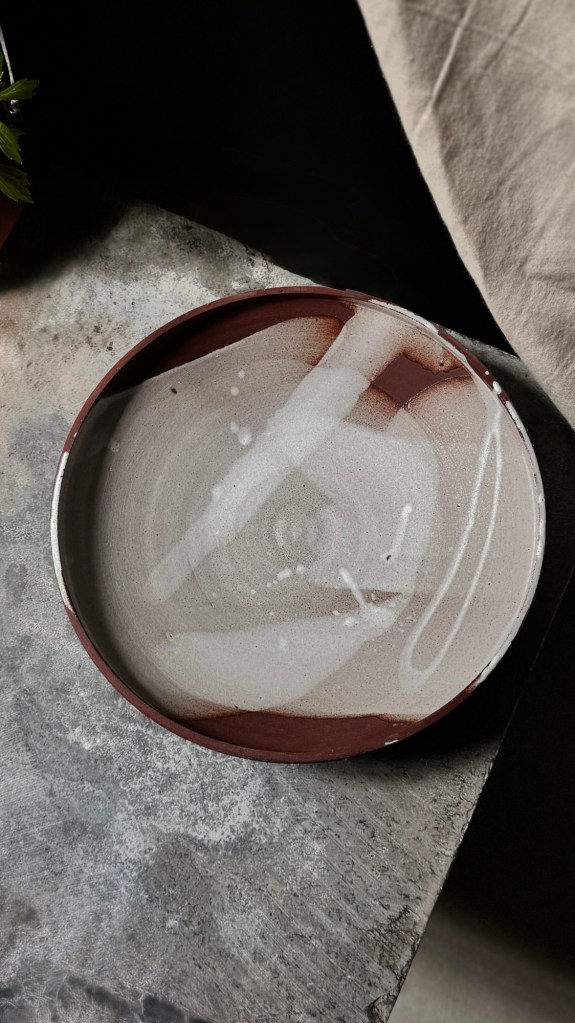
His surfaces are developed through the layering of colored slips, oxides and glazes, using techniques such as dipping, brushing, spraying and splattering. These layers create subtle shifts in texture and color, allowing for visual depth and contrast between matte and glossy, smooth and raw. Over time, his collections evolve visibly, with each firing informing the next. Through ongoing reflection and experimentation, a formal language emerges that is rooted in contrast, precision and tactility.
The Dutch relationship with food and identity forms a subtle but important backdrop to Cas’s thinking. He observes that the Netherlands, lacking a dominant national cuisine, has instead developed a hybrid food culture shaped by migration, colonisation and global exchange. He sees this as both a reflection of broader cultural shifts and a model for how identity is constructed in the contemporary world. In his view, individuals now draw on diverse cultural references to shape their own rituals, values and ways of living — often through objects. Ceramics, as tools of everyday life, become physical extensions of this layered identity. A bowl may reflect memory, belonging or transformation, depending on its context.
Cas sees his work as part of that conversation. By creating objects that are open to interpretation and use, he aims to support both personal ritual and shared experience. His ceramics are not designed to dominate a space, but to become part of its language. Whether used in a professional kitchen or domestic setting, they are meant to invite touch, attention and reflection.
Ultimately, his work offers a quiet but intentional space for complexity. It does not aim to simplify or resolve cultural tensions, but to hold them, to give them form, and to make them available for reflection through use. Ceramics, in this view, are not just containers of material, but vessels of meaning — tools that help us carry who we are, where we come from and how we choose to come together.
 Cas Driessen